|
Space
Weather
Once you've seen it
you'll never forget; it's amazing and fabulous when the sun and the
earth start playing with light. No earthly, human laser-show can
compete with this show which has its source at a very much higher
level. It's known as polar light or the Aurora borealis and is all but
impossible to predict . It suddenly appears and can last for several
minutes or several hours; sometimes days.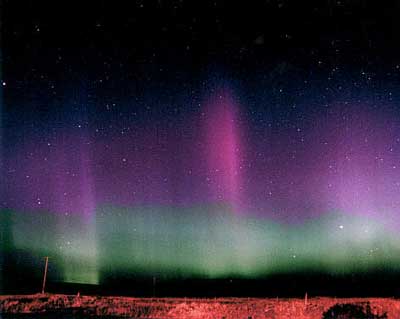
What happens? The sun plays the leading part in this masterpiece.
Sometimes it throws out huge
amounts of hot gas and very fast electrically charged particles. These
particles dash against oxygen- and nitrogen atoms in the upper layers
of the earth's atmosphere. The energy that's been liberated forms the
Polar Light.
Its the most spectacular proof that there's more between Sun and Earth.
This Solar Wind controls everything there; and controls Space weather
which impacts upon our daily life and technology.
A real star in the title role
The Sun is overwhelming important to our life; but how
does it affect Space Weather?
To answer that we need to take a detailed look at the sun..
It is the largest object of our solar system and
contains approximately 98% of the total mass. One hundred and nine
Earths would be required to fit across the Sun's disk, and its interior
could hold over 1.3 million Earths. The Sun's outer visible layer is
called the photosphere and has a temperature of 6,000°C (11,000°F).
This layer has a mottled appearance due to the turbulent eruptions of
energy at the surface.
Three layers are very important: 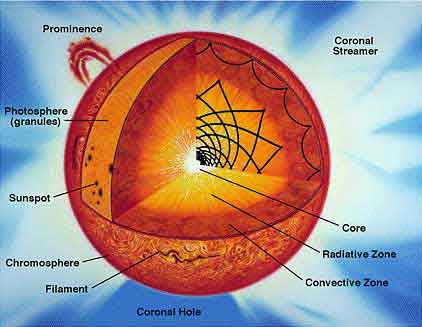
- this photosphere: that's where the sunspots can occur
- the chromosphere above the photosphere. Solar energy
passes through this region on its way out from the centre of the Sun. Flares arise in the
chromosphere., coupled with coronal
mass ejection.
- the corona; that's the outer part of the sun's
atmosphere. In this region the prominences
appear. these are immense clouds of glowing gas
that erupt from the upper chromosphere. The outer region of the corona
stretches far into space and consists of particles travelling slowly
away from the Sun. The corona can only be seen during total solar
eclipses.
Lets have a closer look to these three mentioned
phenomenon.
Sun spots
Sunspots are darker irregular spots at the sun's
surface. Sometimes, when the sun goes down you can see them
with the bare eye. The old Chinese astronomers first described these
spots about 800 BC; but it took till Galileo
Galilei, to study them properly, using his telescope.
Sunspots develop as very tiny stains in the
photosphere of the sun, growing out to a group of huge dark area's that
will disappear again. These
area's have a lower temperature (about 5000 K) than the surrounding
solar surface (6000 K).  That's why
they have a dark colour. Their amount isn't constant; over the last 300 years, the average number of
sunspots has regularly waxed and waned in an 11-year sunspot cycle. The
Sun, like Earth, has its seasons but its year equals 11 of ours. The
last solar minimum was in 1996, and the last maximum was in 2001. The
next expected minimum is 2007.
During these maxims the sun has an enormous magnetic-activity; with
eruptions spitting huge amounts of hot gas into space: solar flares. That's why
they have a dark colour. Their amount isn't constant; over the last 300 years, the average number of
sunspots has regularly waxed and waned in an 11-year sunspot cycle. The
Sun, like Earth, has its seasons but its year equals 11 of ours. The
last solar minimum was in 1996, and the last maximum was in 2001. The
next expected minimum is 2007.
During these maxims the sun has an enormous magnetic-activity; with
eruptions spitting huge amounts of hot gas into space: solar flares.
Solar
flares
The solar flares; develop in the
chromosphere, above the sunspots. They are intense, temporary releases of
energy. From earth's ground-based observatories the flares are seen 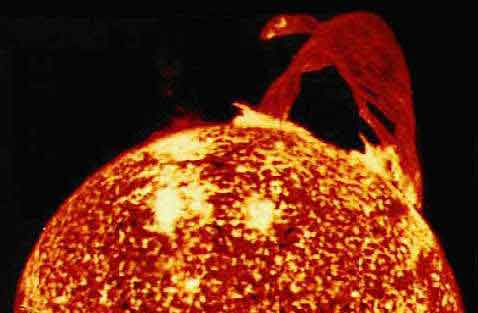 as bright areas on the sun and
can last from minutes to hours. Flares are our solar system's largest
explosive events which can be equivalent to approximately 40 billion
Hiroshima-size atomic bombs. The primary energy source for flares
appears to be the tearing and reconnection of strong magnetic fields.
They radiate throughout the electromagnetic spectrum, from gamma rays
to x-rays, through visible light out to kilometre-long radio
waves. Flares sometimes are
associated with magnetic solar activity; an eruption of quick electric
charged particles: the coronal mass ejection
(CME's). as bright areas on the sun and
can last from minutes to hours. Flares are our solar system's largest
explosive events which can be equivalent to approximately 40 billion
Hiroshima-size atomic bombs. The primary energy source for flares
appears to be the tearing and reconnection of strong magnetic fields.
They radiate throughout the electromagnetic spectrum, from gamma rays
to x-rays, through visible light out to kilometre-long radio
waves. Flares sometimes are
associated with magnetic solar activity; an eruption of quick electric
charged particles: the coronal mass ejection
(CME's).
Lethal
Solar Wind: Coronal Mass Ejections
The
outer solar atmosphere, the corona, is structured by
strong magnetic fields. Where these fields are closed, often above
sunspot groups, the confined solar atmosphere can suddenly and
violently release bubbles or tongues of gas and magnetic fields called
coronal mass ejections. A large CME can contain 10.0E16 grams (a
billion tons) of matter that can be accelerated to several million
miles per hour in a spectacular explosion. Solar material is spit out
into space consisting hot, magnetized, supersonic sort of plasma;
carrying  large amounts of kinetic and
electrical energy. These CME's have an impact on everything in its way:
all the planets, our earth included, unto far beyond
Pluto. This material as you would expect is very hazerdous to
health without proper protection its fatal. large amounts of kinetic and
electrical energy. These CME's have an impact on everything in its way:
all the planets, our earth included, unto far beyond
Pluto. This material as you would expect is very hazerdous to
health without proper protection its fatal.
And it is this "solar wind" that dictates the
Space Weather.
Between
Sun and Earth: interplanetary medium
The region between the Sun and the planets has
been termed the interplanetary medium. Although once considered a
perfect vacuum, this is actually a turbulent region dominated by the
solar wind, which flows at velocities of approximately 250-1000 km/s
(about 600,000 to 2,000,000 miles per hour). Other characteristics of
the solar wind (density, composition, and magnetic field strength,
among others) vary with changing conditions on the Sun. The effect of
the solar wind can be seen in the tails of comets which always point
away from the Sun.
How can we survive that violence?
The
Earth - and all the other planets - has her own way to protect life
against this fatal radiation of the sun. She is also
surrounded by a magnetic field (called the "magnetosphere"); leading
the solar wind away from the planet. Earth's magnetic field can sense
the solar wind with its speed, density and magnetic field. Because the
solar wind varies over time scales as short as seconds, the interface
that separates interplanetary space from the magnetosphere is very
dynamic. 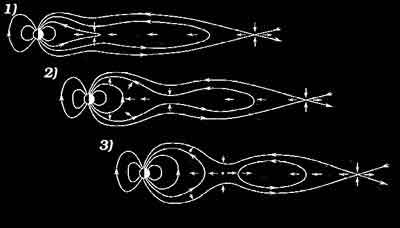
Earth's magnetic field is very similar to the pattern formed when iron
filings align around a bar magnet. Under the influence of the solar
wind, these magnetic field lines are compressed in the Sunward
direction and stretched out in the downwind direction. This creates the
magnetosphere, a complex, teardrop-shaped cavity around Earth. The most
of the solar material can only reach the so-called ionosphere, a layer
of Earth's upper atmosphere where photo ionization by solar x-rays and
extreme ultraviolet rays creates free electrons. Normally the
magnetosphere can keep the Suns violence far away, about 60.000 km in
the direction of the Sun. However, during episodes of elevated solar
wind density or velocity, the influence of the sun reaches further
inward to within 36.000 km (and that's the altitude of the highest
satellites).
Solar
Effects at Earth
In the introduction we started with the most
spectacular and visible effects of Solar Wind: the Polar
Lights.
But there are a lot more impacts of Solar activity perceived at Earth,
and while our satellite- technology grows, the Solar influence evolves.
The Solar Wind disrupts the earth's magnetic field. And, as the
magnetosphere extracts energy from the solar wind, internal processes
produce geomagnetic storms.
These storms are the trouble-makers in our
technology, biology and climate. But sometimes we get something in
return: the magnificent free laser-show called Aurora, polar
lights.
Aurora
The
aurora is a dynamic and visually delicate manifestation of
solar-induced geomagnetic storms. The solar wind energizes electrons
and ions in the magnetosphere. These particles usually enter Earth's
upper atmosphere near the polar regions. 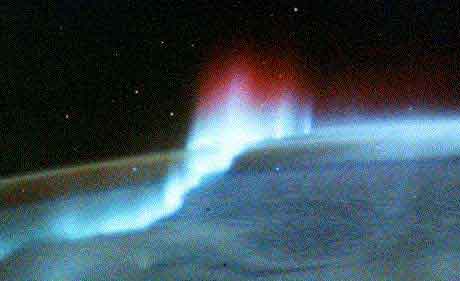 When
the particles strike the molecules and atoms of the thin, high
atmosphere, some of them start to glow in different colours. When
the particles strike the molecules and atoms of the thin, high
atmosphere, some of them start to glow in different colours.
Auroras
begin between 60 and 80 degrees latitude. As a storm intensifies, the
auroras spread toward the equator. During an unusually large storm in
1909, an aurora was visible at Singapore, on the geomagnetic equator.
The auroras provide pretty displays, but they are just a visible sign
of atmospheric changes that may wreak havoc on technological systems.
Our
technology: disrupted Systems
Communications
Many communication systems utilize the ionosphere to
reflect radio signals over long distances. Ionospheric storms can
affect radio communication at all latitudes. Some radio frequencies are
absorbed and others are reflected, leading to rapidly fluctuating
signals and unexpected propagation paths. TV and commercial radio
stations are little affected by solar activity, but for example
ground-to-air, ship-to-shore, and amateur radio are frequently
disrupted. Radio operators using high frequencies rely upon solar and
geomagnetic alerts to keep their communication circuits up and
running.
And also some military detection or early-warning systems are also
affected by solar activity.
Every Aviation
Administration routinely receives alerts of solar radio bursts so that
they can recognize communication problems and forego unnecessary
maintenance. When an aircraft and a ground station are aligned with the
Sun, jamming of air-control radio frequencies can occur. This can also
happen when an Earth station, a satellite, and the Sun are in
alignment.
Navigation Systems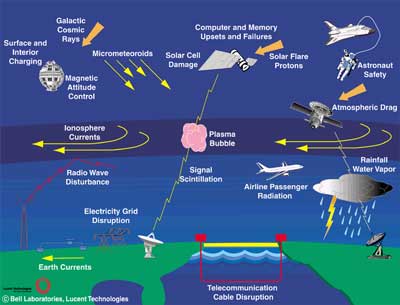
Some
navigation-systems, used on ships and by aircrafts, such as Decca and
Omega, are adversely affected when solar activity disrupts their signal
propagation. These navigation systems consists of transmitters located
through out the world. Airplanes and ships use the very low frequency
signals from these transmitters to determine their positions. During
solar events and geomagnetic storms, the system can give navigators
information that is inaccurate by as much as several miles. If
navigators are alerted that a proton event or geomagnetic storm is in
progress, they can switch to a backup system.
GPS signals; are less sensitive, but can be affected when solar
activity causes sudden variations in the density of the ionosphere.
Satellites
Geomagnetic
storms and increased solar ultraviolet emission heat Earth's upper
atmosphere, causing it to expand. The heated air rises, and the density
at the orbit of satellites up to about 1000 km increases significantly.
This results in increased drag on satellites in space, causing them to
slow and change orbit slightly. Unless low-Earth-orbit satellites are
routinely boosted to higher orbits, they slowly fall, and eventually
burn up in Earth's atmosphere.
Skylab is an example of a spacecraft re-entering Earth's atmosphere
prematurely as a result of higher-than-expected solar activity. During
the great geomagnetic storm of March 1989, four of the Navy's
navigational satellites had to be taken out of service for up to a
week.
As technology has allowed spacecraft components
to become smaller, their miniaturized systems have become increasingly
vulnerable to the more energetic solar particles. These particles can
cause physical damage to microchips and can change software commands in
satellite- borne computers.
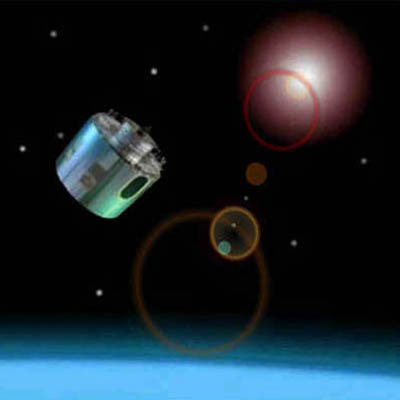
Differential
Charging
Another problem for satellite operators is
differential charging. During geomagnetic storms, the number and energy
of electrons and ions increase. When a satellite travels through this
energized environment, the charged particles striking the spacecraft
cause different portions of the spacecraft to be differentially
charged. Eventually, electrical discharges can arc across spacecraft
components, harming and possibly disabling them. Bulk Charging. Bulk
charging (also called deep charging) occurs when energetic particles,
primarily electrons, penetrate the outer covering of a satellite and
deposit their charge in its internal parts. If sufficient charge
accumulates in any one component, it may attempt to neutralize by
discharging to other components. This discharge is potentially
hazardous to the satellite's electronic systems.
Climate
So the sun has surely influence at the earth's
atmosphere. But does the variable solar activity also affect the
climate?
The eleven-years cycle should be recognized in the
weather-registrations and other effects. For more than a century
researchers are trying to find possible relations.
Its known that there were only a few solar spots during the little Ice
Age, from 645-1715. You can also think of the amount of solar spots and
the crop-yields during the years.
Since 1979, there are accurate satellite data, showing
that you can hardly find a connection with the eleven-years cycle in
solar activity and the average earth temperature. The variation in
temperature is less than 0,01 C.
But there are more and more indications that slower
variations of solar activity surely has its impact on the earth's
climate.
Recent research has made clear that part of the global warming, in the
first half of the 20the century, can be explained as a combination of
less volcano-activity (volcanic eruptions cools the atmosphere) and an
increase of solar activity. So merely natural causes for global warming.
During the second half of the 20the century however, global warming can
be explained by human activity, as both the solar -and volcano-activity
didn't change.
Other effects: biology,
electricity, astronauts and pipelines
But there are more effects: researchers have
found that animals with navigational abilities, like pigeons, whales
and dolphins, are very confused during a geomagnetic storms: they seem
to loose their natural ability of navigation.
A geomagnetic storm can be harmful for electric
transmission systems. As a result of a huge geomagnetic storm, 6
million people in Montreal, Quebec were without electric power. Some
other area's in the US and Sweden also lost power.
Rapidly fluctuating fields can induce currents into pipelines.
And last but not least: astronauts can be injured by intense solar
flares. Humans on earth are protected by the earth magnetically field,
but in space humans are subject to the lethal and violent solar wind.
Space weather
Only during the past few decades it has been
realized that solar activity can harm and affect life on earth. Of
course with the growth of our technology, the influence of the Solar
Wind increases.
The research to solar activity and the impact
on human life has become a very important issue in all kinds of
disciplines.
Want to know
more? Visit:
www.spaceweather.com
With
thanks to NOAA for provided information.
Mail to: wijke@scribeweekly.com
|
